Friday, November 30, 2012

"Some Are Born..."


Three-year-old Jacob stomps into the bathroom like a toothbrush wielding sumo.
His sing-song opera…“I am the youngest. You are the oldest.
But I am the STRONGEST! Ha! Ha! Ha!”
The older brother, no Esau, but a Joseph, pats him on his flaxen head,
And calmly douses his outstretched weapon with toothpaste.
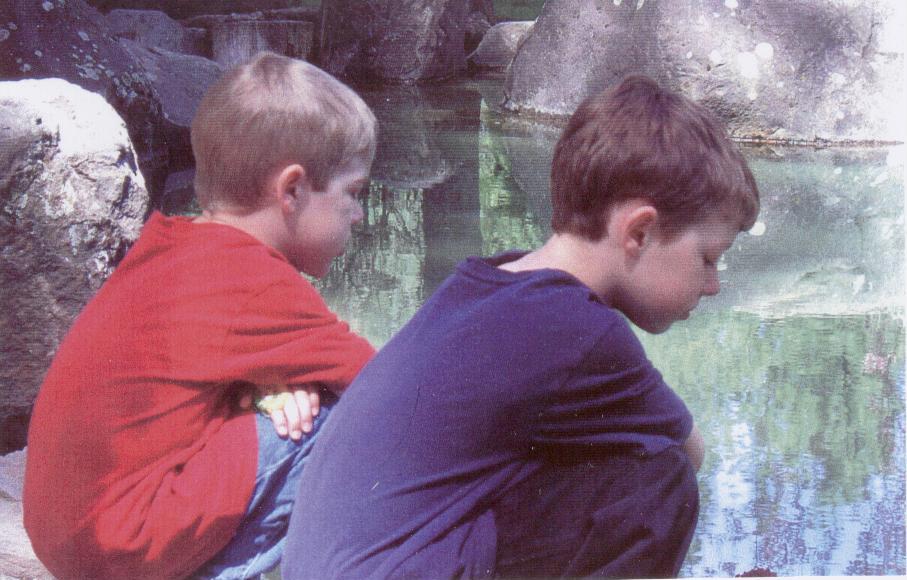

These days, I’m attempting to make the psychological shift from nurturer of children to parent of nearly grown men. I wouldn’t for a million dollars exchange today for yesterday – but I can’t help but reminisce. I wrote the poem above when my sons were toddlers and, obviously, I’m more a prose girl. But sometimes I get the urge to wax poetic, and this silly poem is one of my favorites. It’s a snap shot of a moment in time, but it speaks volumes about the personalities of my two sons and their brother relationship.

Watching my sons brings other brother pairs to mind – my father and his younger brother, Wilbur and Orville Wright, and of course, Jacob and Esau. Each of my sons has respected the other’s strengths, and put up with each other’s annoying qualities, in a mostly good-natured manner over the years– this has been a gift. The interaction of my sons has also led me to conclude that the Biblical story of Jacob and Esau is as much, and possibly more, about the older brother as it is about the younger.

I ruminate about being an eldest, not through experience, but through observation. I am neither the youngest nor the oldest – I’m not even the middle. I am third of four siblings. I am the watcher, the chronicler of the family I was born into.

I am also the mother of an eldest, and the close friend, sister, daughter, and wife of eldest children, and I know this: it is not easy to be an eldest. Your person, the idea of you, your very existence, is imbued and burdened with the hopes, dreams, and expectations of those around you from the day you are born. It would be impossible not to disappoint at some juncture, but you are never free of it – that sense of being responsible, the natural burdens of authority and leadership. There are perks, to be sure, but they come with strings. You will never be free (like a third) or pampered like a youngest or an only child (circumstances of birth that come with their own challenges). Being the eldest sibling is the original, “What have you done for us lately?” job.

I completely understand Esau wanting to be free of the responsibilities of the eldest, and that understanding has made me come to admire the eldests in my life that much more. These eldests that I love could have walked away, sold their birthrights. As far as I can tell, it doesn’t enter their minds.

As I think about it, I remember that each of them has had their older sibling prodigal moments (“Dad, why do you let them get way with that? When I think about the thrashing I would have received had I…”) but these indignant moments tend to be brief. I have watched them take the lead in helping aging parents, keep the family connected by both encouraging and speaking the truth in love, always ready to step in when there is a need or challenge that the rest of us feel inadequate to face, advise and project confidence that reassures us about continuing on. Far from selling their birthright, they often refuse even the slightest offer of help – assistance that some might say only pride keeps them from accepting. It as if they were also born with some innate sense that this role is theirs to fulfill and no one else’s, so they err on the side of sole responsibility. By the grace of God, I am what I am, and His grace toward me was not in vain. (I Cor. 15:10) This isn’t pride. It is obedience.

What of the rest of us? The younger, the middle…the third. Can we learn something about our own calling by watching them? Another of their responsibilities, that, teaching by example. God gives us the choice to be or not to be what He created us to be. We’re free to walk away. He doesn’t need us to help Him fulfill His purposes. But running away tends to end in a pigpen, or the belly of a whale, or grieving at a birthright cheaply sold. My eldests have taught me it is good, no matter how rough the path, to follow the one God has placed before us, refusing to be distracted by smoother seeming ways. We look to Him at each twist and turn and say, “Where next?” People are blessed by that action, both the person who acts, and those they travel with, as well.


Friday, November 9, 2012

And This We Know


Adam and Eve and their story have come to my mind often during this past election season. In the third chapter of Genesis, Adam and Eve rebelled against their Maker. The next thing they did was try to justify their positions. The fact that their actions were in direct contradiction to God’s words didn’t even come up. The point seemed to be, for Adam and Eve, that what they had done seemed the most reasonable course of action given the circumstances, and why couldn't God understand that?

Whether you believe Genesis is history or myth, it has survived because it points to the root of so many of humanity's struggles. This tendency to justify our position in an argument or controversy, rather than listen and truly examine our own assumptions, motives, and actions, is a bad habit we can't seem to shake. As far as I can tell (and this most recent election season was a good bellwether) this tendency toward self-justification is as rampant in the Church today as it is outside of it.

I know I am just as guilty of this error as the next believer, but God’s been working on my heart in this regard. As far as I know, nowhere in scripture do Christ or the apostles exhort us to defend our political or moral positions to the death. Why it took me so long to notice this, I really don’t know, but I am sure it has its root in our fallen human tendency toward self-justification. We are called to defend and guard the gospel – to encourage each other to remember and pass on the pure and unammended good news we were given.

“Now I make known to you the gospel that I preached to you, which also you received, in which also you stand, by which also you are saved, if you hold fast the word which I preached to you, unless you believed in vain. For I delivered to you as of first importance what I also received, that Christ died for our sins according to the Scriptures, and that He was buried, and that He was raised on the third day according to the Scriptures.” (I Cor. 15:3-5 NASB, emphasis mine)

"Guard what has been entrusted to you." (I Tim. 6:20 NASB)

However, guarding the gospel does not mean endlessly justifying our interpretation of how it should be lived out. It does not mean reacting in anger and condemning people who don’t buy it. Paul was clear that guarding the gospel simply meant passing on the same news that Christ gave to the apostles, and that they passed on to the early church. That’s it. I find nothing in scripture that suggests we are called to defend or justify our church’s doctrine, our political positions, or our lifestyle choices.

There is nothing wrong with having strong views and opinions, any thinking person does. I enjoy a good discussion as much as the next girl. But if our discussions become lines in the sand that separate  us from each other, that fracture relationships rather than exhort, encourage, heal, and draw people to Christ, something is wrong.

Think about some two sentence summaries of New Testament books of the Bible. Here are a few to get you started - Corinthians: God is the judge, you are called to love - love God and love each other. Some ways you can love each other are: sacrificially caring for those who are poorer and weaker than you, watching what you say, and passing on the same gospel message I gave you. James: Watch what you say, help each other remember the gospel, and take care of the poor and the weak among you. If you believe what you say, your life will show it. Romans: This isn't about what you're doing, it's about what God's doing in you. Oh, and watch what you say and take care of those poorer and weaker than you.

Picture what it would be like if the most important point we wanted to make in any discussion was the hope of the gospel message. It wouldn’t take long for us to explain what is important to us, and after that, what would we be doing? Listening, and I have found that to be important for two reasons:

First, the odds are, no matter how right or mature we think we are, some of our opinions and actions and yes, even some of our interpretations of scripture, are wrong. One of God’s best ways to show us where we are in error is through the encouragement, exhortation, and correction we receive from other people. They get the opportunity to speak truth to us in love. We have the opportunity to admit we are not perfect.  In turn, our brothers and sisters share the mercy of Christ with us as they forgive us for our error. Done right, this is a beautiful, miraculous, relationship enhancing cycle. It could be argued that, after sharing the gospel and helping the poor, learning this cycle is the primary role of church communities in the lives of believers.

Second, it is impossible to know someone that we do not listen to. It is very hard to understand how to love another person without knowing them. We are called to love our fellow believers and the world the way that Christ loved. We cannot love others if we spend the majority of our time talking rather than intentionally listening - listening in order to understand, not in order to defend our positions.

I have traced my own issues with self-justification to a lack of trust in the promise of Romans 8:28. “And we know that God causes all things to work together for good to those who love God, to those who are called according to His purpose.” And we know… Do we really? Do we really trust that God is doing exactly the work that He has promised in our lives, the lives of our fellow believers, and in the world He created and loves? If we really believe this, we will not be afraid - and we won't be afraid to listen.

Sunday, October 14, 2012

Keep Climbing


“We are not necessarily doubting that God will do the best for us: we are wondering how painful the best will turn out to be.”

Photo by Gina Pearson
Quick! What does this C.S. Lewis quote have to do with Polish mountaineers? In my opinion, one of the best outdoor articles ever written appeared in National Geographic a few years ago, and I’ve never been able to shake it (Himalaya Winter Climb, Mark Jenkins, 2008). During this season when temperatures start to plunge, it comes back to me. I remembered why when a friend forwarded this Lewis quote a few days ago. Outdoor enthusiasts regularly quote this article, however, I guess I saw it in a little different light than most others.

There was a group of Cold War-era Polish mountaineers who believed they were made to summit tall mountains. Stuck behind the Iron Curtain and cut off from all the highest peaks, the Poles began climbing in the dead of winter, when their mountains were at their coldest and stormiest. Winter mountaineering became identified with Polish climbers. As one of their early heroes would say, “Tell me what you have done…in winter, and I’ll tell you what you are worth.” Other climbers labeled them “Ice Warriors.”

When the Iron Curtain started to “crack” in the 1970s, it opened up new opportunities for these, by now, famous climbers. They convinced the Nepalese government to issue them the first ever winter permit to climb Everest.  Everyone thought they were crazy, suicidal, but “by character, by desire, and by experience, Polish mountaineers were inured to cold, wind, darkness and danger.”

In February of 1980, the Poles summitted Everest, the first winter ascent of an 8,000-meter peak. By the time I read about them, about half the 8,000 plus meter peaks in Asia had been summitted in winter by the Poles. But the original climbers were all in their fifties and sixties – grandparents – and so they sent out a challenge to the younger Polish climber jocks who had all taken up the easier summer climbing. Conquer the remaining six peaks in a winter climb and “you may count on us,” the older climbers said. “You may count on our help, our experience, our active participation. The choice is yours.”

Some of the younger climbers took up the challenge.  The older, more experienced winter climbers would go ahead of the younger ones.  They would scale the ice cliffs, secure the pitons, run the ropes, create the base camps – and the younger ones would follow.  Asked why they would put their aging bodies through that kind of torture, the most experienced member of the old guard said he wanted to “infect” a new generation of Polish climbers with “the joy of positive suffering – because if something is easy, you will not enjoy it, really.”

Back to Lewis's quote - here we have the Master Climber ahead of us. He’s given us the challenge of summitting, we have taken it up. He goes before us, scales the dangers, drives in the footholds, secures the guidelines, and asks us to follow. The avalanches, the rocks that fall, and the crushed bodies happen because there is sin in the world, yes. But He brought us to this particular mountain...in the middle of winter. He knew what we would face here. He knew we would be pushed to the brink of endurance, and He knew it would hurt. What we really want to know is this: Why make summitting so difficult? Why not the easy climb?

I don’t know the answer to that, but maybe this is part of it – He intends to infect our natures with the joy of positive suffering. If our goal is to summit, we need to live the truth that nothing truly good is easily accomplished - and what God intends to complete in us is nothing less than true goodness.

We are winter climbers who have never summitted. But the Master Climber tells us it’s worth it, we won’t regret it, we were made for this, and he promises we’ll make it. He’s been there, so we trust Him. We dig in, grab on, fix our gaze on his dim shape ahead in the snowy twilight – and keep climbing.

Thursday, October 4, 2012

Zukunftsangst


We can get bogged down in the what-ifs, yet here in the Intermountain West, Fall has come anyway. The stifling haze from fires that ringed our valley all summer long has given way to the alpine lake blue of a cloudless autumn sky. Cold nights and warm days have left us canopied and covered in stained-glass colors. The long shadows mean rest for the land, and invite us to stop and savor the moment as well. I don’t pretend to know what the future holds for us, but I do know that days like these are gifts. If we drink them in and fill ourselves to overflowing with their beauty and wonder, they can sustain us.
I was reminded of this recently in an unlikely place. From the sublime to the ridiculous? Perhaps. I am not one to claim that everything I know I learned from my dog, but inspiration can come in small and surprising packages, especially those that embody unwavering devotion, easy forgiveness, and the joy of the moment.


He has found the perfect spot. The floor is freshly cleaned and has been gently heated these two hours since sunrise. He began here by staring, quivering and intent, through glass doors at the tall grass just beyond the strip of lawn. There are rabbits there. After an hour or so of no rodent encroachment, he relaxed into a sphinxlike pose. After another thirty minutes, all safe, he rolled onto his side. The white fur on his belly is radiant while his sleek flank shimmers blue, absorbing the light. Even his back, which would normally rest in cold shadow, is heated by the reflected warmth from the chair behind him. Last, but most important, his boy is near. He can hear him breathe. This is complete relaxation, all his good things coming together, and is rare for a hound like him.
He is not aware yet of the one thing that could disturb his rest. The upholstered chair he is snuggled against is not firm. It swivels.
The boy reading in the chair softly closes his book, but a finger holds his place. He looks to the clock on the wall and sighs. The chair moves to the left ever so slightly. The dog raises his head, blinking drowsily in the morning light. The muscles in his tiny body tense. Is this the end? The boy moves his head from side to side, yawns, stretches his legs and crosses them. Resettling, he opens the book, but the dog remains alert.
Does the chance that the chair might swivel outweigh the comfort of warmth? Does the realization that it will end destroy the joy of a perfect moment? His ears twitch, as if someone is whispering the answer. Slowly, his muscles relax and appear to melt in the pool of sunlight. His small head flops to the floor with a soft thud. His eyes close. Bliss.


Sunday, September 23, 2012

What Was From The Beginning


What was from the beginning, what we have heard, what we have seen with our eyes, what we have looked at and touched with our hands concerning the Word of Life…

Picture the apostles, the struggle and responsibility. How to communicate the truth of their life-changing relationship with Jesus? Inspired by God, yes. Still, they were faced with the challenge of explaining what they had seen and experienced while Jesus was with them, and all that they had come to understand about the infinite breadth of God’s love for us. Far away from those other believers struggling to understand, somehow, the apostles had to speak the truth of it – in writing. Did they think, “How much will they really understand? How much can we hope for?” They wrote, and covered their words in prayer.

I hesitate to write about being a Christian and a writer. Even after forty-some years of trying to do it creatively, twenty of those semi-professionally, I still consider myself a novice. I feel the same about my relationship to the Word of Life. The two are bound up together and inextricably linked. I want both to be whole and healing, but how much can I hope for in this life?

…and the life was manifested, and we have seen and testify and proclaim to you the eternal life which was with the Father and was manifested to us…

How to communicate the seminal experience of your life, to those who have known only a fraction of the same experience, if at all? The apostles came to understand God’s eternal nature, His power, love, and sovereign goodwill toward us, as they walked the earth with God manifested – with the man, Jesus. They saw Him, touched Him, spoke with Him, heard the words from His own lips. They loved Him as a friend before they loved Him as their God. “You can, all of you, have this same rich experience of God,” they seem to be saying. “Listen! You can know this fellowship, too, and for an eternity.

Do I feel like such a novice because I’ve barely begun? Will I continue to ponder and illuminate my eternal relationship with the Word of Life through a heavenly version of creative writing...forever? Will I continue to improve, always increasing in understanding? “Further up and further in.” Infinitely? A heartening thought, that endless possibility.

...that we have seen and heard and proclaim to you also, so that you too may have fellowship with us; and indeed our fellowship is with the Father and with his Son, Jesus Christ. These things we write, so that our joy may be made complete.

It seems the apostles never stopped trying, even to the point of death, to explain what their experience of Jesus and His death and resurrection mean for all of us. In every way they could think of – metaphorically, poetically, creatively, scholarly, in simple language and lawerly, sometimes just the straight, unvarnished facts – no holds barred, all genres employed, to communicate the truth. They believed that these things they wrote, and the results of their writing, completed what was begun the day they met Jesus.

A God who knows us and wants to be known by us is a miraculous thing - it is almost unbelievable. It is also the only thing that makes sense, our only cure, and our only way home. It seems I, too, am compelled to keep trying to explain the joy and freedom I have found in this fellowship with the Word of Life. I struggle to do it in every way I know how, in my relationships, my work, as I “come in and go out,” as I write. There isn’t just one way. It doesn’t have to be chapter and verse. Except sometimes. Sometimes it does. These things I write, so that my joy may be made complete.

Monday, September 3, 2012

Lola 2


This is the second in a series, catch the first one in the archives on the right to catch up!

 Personally, one of the things I most love about God is His incredible creative genius. We, being created in His image, are also made to create. When I see what we humans come up with, imperfect as it is, it makes me happy. It makes me glorify God. I can honestly say, part of what’s going on when I’m enjoying The Kinks’ song, Lola, is that I admire the creativity it exhibits, and it makes me think about the Creator who created the creator who created Lola.

  I don’t have this experience with all art. There is a lot of really bad art out there – a surprising percentage of which is created expressly to mock God and another percentage that’s created to do the opposite, but because it isn’t well thought out or true, it ends up mocking God all the same. However, I don’t believe this is true of Lola, or of a lot of “secular” art in general. Yes, I believe that God would probably be grieved at the lifestyle and culture that a song like Lola comes out of, and I should be, too. But Lola doesn’t glorify the lifestyle – in fact, part of the genius of the song is that it makes fun of itself. 

   It tells a story that people have loved in all its different forms for more than a thousand years – the country rube goes to the city, and he thinks he’s all that, because he got away from the sticks-in-the-mud in his small town. Practically the minute he gets off the bus, he makes a huge mistake due to his ego, stupidity and naïveté, that most people (including the audience) could see coming a mile away. Ultimately, the mistake leads to greater self-knowledge.
  
 By 1970, this story has been told a hundred different ways – everyone has heard it more than once. Yet, Ray Davies takes it and sets it to the bizarre chorus of the life he found himself in. With one bold, humorously self-effacing song he and his mates exhibit a cutting edge musical style, an amazing set of lyrics, and an astute commentary on society in general. I would say that’s worth admiring and, yes, even emulating.  Because there isn’t much new under the sun, and if Christian artists were striving to do what the Kinks did, and setting it to the chorus of their lives in Christ, think what kind of art we Christians would be producing. It’d be different than most of what we have currently – it would be better.

“…Girls will be boys and boys will be girls.
It’s a mixed up muddled up shook up world…”

  The words still apply. Seriously, I’d rather not struggle with this. I’d much rather play it safe.  It wouldn’t kill me if I never heard Lola again. I could go all Amish and walk away from pop culture altogether, it would be easy. I have that kind of personality – I home school my kids – I’m half-way there already.

  Except…except…Jesus never played it safe. Not once that I know of. It seems like most Christian artists are happy to do so, though. We’re pretty sure we know what we shouldn’t do, but that doesn’t get us anywhere until we hit on what we should be doing. Kind of reminds me of some other lyrics, by another of my favorite bands, 

“…The trouble is
We don’t know who we are instead…”

  I could walk away from Lola and all of pop culture, but that wouldn’t change anything, because I’d still be the girl who loves Lola. Isn’t that the heart of it – my desire? If Lola is wrong to listen to, it’s not that there needs to be less Lola in the world – there just needs to be less Lisa.

Thanks to Erika and her friends for the awesome picture!


Monday, August 27, 2012

Lola


Photo by Melissa Rose  
  There are a lot of famous Lolas out there, but the Lola of my title is the name of a song first released in 1970 by a Beatles-era band called The Kinks. I don’t actually remember hearing Lola for the first time until I was in high school – a good ten years after it was originally released in the UK. A survey of most of my peers reveals similar memories. I think the timeline went something like this: The Kinks were kind of the progenitors of punk rock, and the late ‘70s and ‘80s were when punk went pop. So all the people who wanted to be cool, but weren’t really, were into punk. Of course, that led to lots of Kinks retrospectives in places like MTV and a big Kinks concert tour in the ‘80s, and I guess the rest is history.

  For a certain segment of the population, which I happen to belong to, when Lola comes on the radio, we magically lose our inhibitions and start to sing “Luh, luh, luh, luh, Lola!” at the top of our lungs. It causes a sort of spontaneous flash mob where people stop what they’re doing, sing Lola together, and when the song ends, go calmly about their business. In my experience, this phenomenon can cross a lot of age, cultural, and religious boundaries – despite the fact that the song is about, as Wikipedia so primly puts it, “a confused romantic encounter with a transvestite.”

  It has been argued that The Kinks were the bridge from the rock ‘n roll of the ‘50s to the rock, punk, and New Wave of the ’70s and ‘80s. So I guess it is no surprise that they recorded some music that still makes people sit up and take notice. But my interest in this song goes beyond the academic. To put it simply, Lola rocks. While I would like to say it is the guitar riffs that I love and I don’t really listen to the lyrics, this wouldn’t be true. Of course, I wish the subject matter was different, but the lyrics are extremely clever. As a writer, I can’t help but smile and mentally applaud every time I hear them.

  Then I feel guilty as a Pharisee at a pork festival.  I can rationalize with the best of them, but it’s pretty hard to reconcile my love of Lola with “Whatever things are pure…” I feel similarly conflicted about other aspects of pop culture that I participate in on a regular basis. Being in the world but not of the world. Easier said than done – or is it? Jesus and I have been walking the road together for thirty-seven years, and I still find it difficult to walk this particular line. It affects everything in my life, from my relationships to my writing. So what’s a girl to do? I’ll think about this some more in my next post, but in the meantime, I am interested in your thoughts. Sing it with me now, “Luh, luh, luh, luh, Lola!” 

(Hear the song: Lola )